

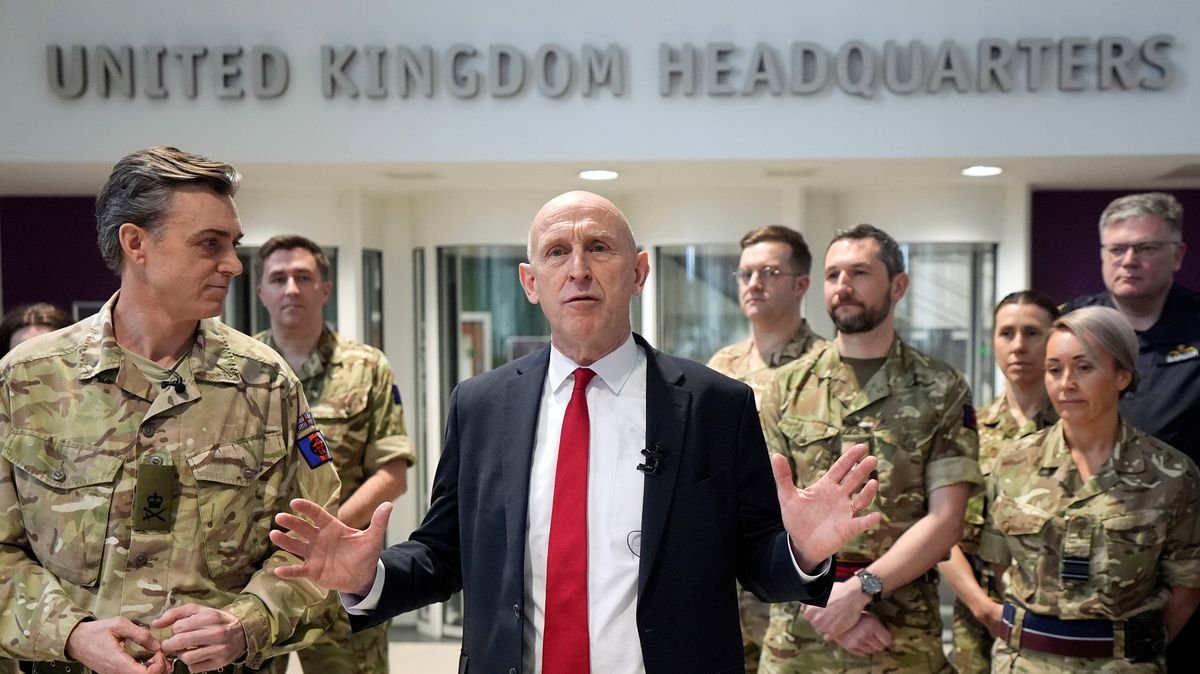

British military forces successfully thwarted an effort by Russian submarines to conduct surveillance on critical undersea cables during a period when global attention was focused on the Iran crisis, according to the Defense Secretary. John Healey issued a stern warning to Russian President Vladimir Putin, declaring, “We are aware of your actions,” as he disclosed a clandestine operation by Moscow to monitor essential infrastructure in the north Atlantic. The Royal Navy deployed a Type 23 frigate HMS St Albans, RFA Tidespring, and Merlin helicopters to monitor the Russian Akula class nuclear-powered attack submarine and two spy vessels in an operation involving over 5,000 British personnel.
Utilizing sonobuoys, which are acoustic sensors designed to detect, classify, and track underwater threats, the military deterred Russia from compromising undersea cables. Additionally, RAF crews conducted more than 50 sorties using P-8 Poseidon submarine-hunting aircraft, with assistance from allies like Norway.
During a press conference at Downing Street, Mr. Healey directly addressed the Russian President, emphasizing, “We are observing your activities near our cables and pipelines, and any attempt to disrupt them will not be tolerated and will result in severe consequences.”
He highlighted that this recent action occurred during a period when global attention was focused elsewhere, referring to the Middle East crisis, but emphasized that Russia remains the most significant threat to the UK. He stated, “It is evident that Putin would prefer us to be preoccupied with the Middle East.”
Acknowledging Russia as the primary threat to the UK and NATO, Mr. Healey pledged to maintain vigilance over Putin’s activities while safeguarding British interests and supporting allies in the Middle East.
Prime Minister Keir Starmer affirmed the government’s commitment to protecting British citizens from the repercussions of Putin’s aggressive behavior. He emphasized the determination to expose Russia’s destabilizing activities aimed at testing the resolve of the UK. Starmer reassured the public that the UK’s Armed Forces are among the world’s best and affirmed the government’s dedication to defending national and economic security globally.
The Defense Secretary revealed that a Russian attack submarine had been observed entering international waters in the High North several weeks ago, with continuous monitoring by British forces. It was revealed that the submarine may have been used as a decoy to divert attention from two specialized submarines belonging to the Main Directorate for Deep-Sea Research, a secretive Russian agency accused of conducting underwater surveillance activities.
The Ministry of Defence released satellite images of Olenya Guba, Russia’s naval base in the High North, amid concerns regarding Russian threats to a vast network of undersea cables and pipelines crucial for international telecommunications and data traffic. These cables also carry a significant portion of global banking transactions and trade activities, as well as a substantial amount of the gas used for heating homes. There is no evidence indicating damage from the recent incident.
The UK’s defense capabilities have faced increasing challenges, with a 30% rise in Russian vessels operating in UK waters over the past two years. Notably, a spy ship, the Yantar, previously targeted RAF pilots with lasers, but has not returned since the incident, suggesting a deterrence effect.
Mr. Healey highlighted Russia’s deployment of a warship to escort sanctioned shadow fleet tankers as a response to the UK’s threats to seize the vessels. He indicated that the UK’s actions had influenced Russia’s behavior, noting that no vessels had been seized thus far.
Reports from The Telegraph indicated that a Black Sea fleet frigate accompanied two shadow fleet vessels along England’s southern coast, with the British tanker RFA Tideforce following closely behind.
Mr. Healey defended the UK’s deployment strategy amid criticism and dismissed disparaging comments from US President Donald Trump regarding UK military assets. He emphasized the importance of actions over words and reaffirmed the UK’s commitment to its carriers and Nato obligations, emphasizing the need for European Nato nations to increase their contributions.
As tensions persist following the Iran crisis, Mr. Healey underscored the importance of deploying military resources effectively to address both visible and hidden threats, emphasizing the need for strategic resource allocation based on national interests and defense priorities.