

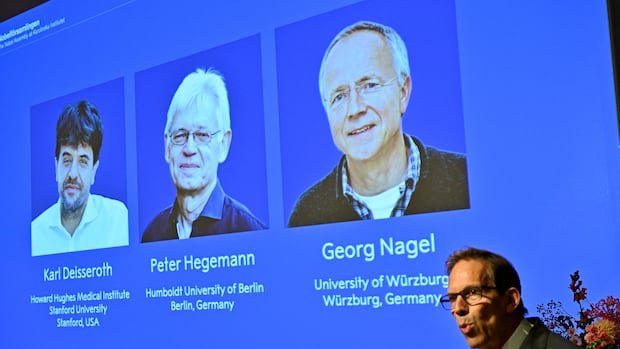

Three scientists, Karl Deisseroth, Peter Hegemann, and Georg Nagel, were awarded the 2026 Nobel Prize in Physiology or Medicine for their groundbreaking work on light-gated ion channels and optogenetics, according to the Nobel Assembly at Karolinska Institutet in Stockholm. Optogenetics enables the manipulation of individual nerve cell activity in the brain, unlocking the brain’s mysteries globally.
The laureates, Deisseroth from the United States, Hegemann, and Nagel from Germany, expressed their delight in sharing the prestigious award with each other, emphasizing their friendship. The prize, worth 12 million Swedish crowns ($1.7 million Cdn), will be divided among the three researchers. Deisseroth is affiliated with Stanford University, Hegemann with Humboldt University in Berlin, and Nagel with the University of Würzburg in Germany.
Optogenetics has paved the way for revolutionary advancements in neuroscience. It has shown promise in restoring vision for individuals with retinitis pigmentosa and enhancing cochlear implants for improved auditory nerve stimulation. Per Svenningsson, a neurology professor at Karolinska Institute in Sweden, highlighted the potential of optogenetics in activating healthy cells to generate visual perception in patients with vision loss.
The journey to this groundbreaking discovery began in the early 1990s when Hegemann studied the light response of the alga Chlamydomonas, leading to the identification of channelrhodopsin-2 as a light-sensitive ion channel. Deisseroth later demonstrated the application of optogenetics in generating electrical impulses using light in nerve cells.
The Nobel Prizes for physics and chemistry will follow, with literature and peace prizes to be awarded later in the week. Alfred Nobel, the creator of the Nobel Prize, designated in his will that his estate should fund prizes for those who have made significant contributions to humanity. The awards will be presented to the laureates on December 10, commemorating Nobel’s legacy.