

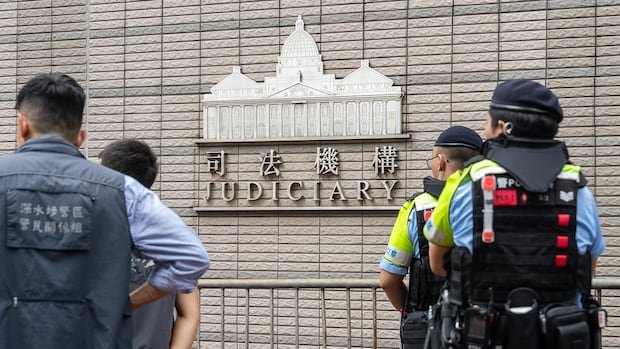

Two individuals who previously coordinated Hong Kong’s annual vigil commemorating the 1989 Tiananmen Square crackdown were found guilty on Friday in a national security case prosecuted under a law imposed by China, which effectively stifled the city’s once vibrant pro-democracy movement.
Lee Cheuk-yan and Chow Hang-tung, former leaders of the Hong Kong Alliance in Support of Patriotic Democratic Movements of China, were accused in 2021 of inciting subversion under the national security law. Despite pleading not guilty, they now face a maximum prison sentence of 10 years. The alliance itself was also convicted.
According to the three judges, the alliance’s plea to “end one-party dictatorship” was interpreted not as a call for the ruling Communist Party to revert to a multiparty system under the constitution but to abolish its leadership status within the constitution. They clarified that the term “end” implied “overthrowing” and “undermining.”
The judges stated in the ruling that the defendants persisted with their advocacy even after the law’s enactment, disregarding that it violated the constitution, which designates the party’s leadership as a fundamental aspect of socialism with Chinese characteristics. This contravention falls under the category of “other unlawful means” outlined in the security law, as per the judges.
This ruling is the latest development concerning Hong Kong’s previously active pro-democracy movement, which has been largely dismantled by authorities in Hong Kong and China.
For thirty years, the candlelight vigil organized by the alliance served as the primary large-scale public event that attracted tens of thousands annually to mourn the victims of the Tiananmen Square tragedy in China. The gathering was prohibited in 2020 during the initial year of the COVID-19 pandemic, just before Beijing enforced the security law on Hong Kong to suppress the extensive anti-government demonstrations of 2019.
Lee and Chow displayed smiles and waved at onlookers in the public gallery before departing the courtroom. Their sentencing is expected at a later date, with a plea for reduced penalties scheduled for the following week, as stated by one of the judges.
Observers perceive their trial as emblematic of the diminishing freedom of expression in the former British territory, which reverted to Chinese governance in 1997.
The judges refrained from disclosing the rationale behind the conviction during the trial, noting that the full judgment would be accessible online later.
Eric Lai, a senior fellow at the Georgetown Center for Asian Law, highlighted that the charge of inciting subversion is frequently employed in mainland China to criminalize the activities of human rights advocates, activists, and intellectuals, including the late Nobel laureate Liu Xiaobo.
Lee and Chow were accused of instigating the overthrow of the ruling party in China. Prosecutors stressed that the case was not politically motivated but focused on what they perceived as the alliance’s call to incite others to challenge the leadership of China’s ruling Communist Party through illegitimate means, citing the demand to “end one-party rule” as a central issue.
However, Lee argued in court that the call aimed not to terminate the party’s leadership but to advance democracy and allow the people to select their leaders, emphasizing that the Communist Party should not enforce “dictatorship.”
Chow, who represented herself as a barrister, contended that “ending one-party rule” signifies putting an end to unchecked power. She criticized the reversal of standards for determining what is right and wrong in this case.
In a Patreon post on Thursday, she recounted being constrained in handcuffs, waist chains, and ankle restraints for court appearances from prison, describing how correctional officers led her as if she were a “dog.”
“The true measure of justice lies within the hearts of the people. There is no need to rely on top-down rulings, and one verdict does not hold significant weight,” she remarked.
Initially slated for a 75-day duration, the trial progressed more swiftly than expected and concluded its final arguments on the 24th day. Albert Ho, another defendant in the case, entered a guilty plea at the trial’s onset, a move typically associated with a potential reduction in sentence.
Lee and Chow are anticipated to seek mitigated penalties in a subsequent hearing and may be sentenced alongside Ho.
Following the verdict, Lee’s wife, Elizabeth Tang, expressed disappointment and frustration with the outcome, despite it meeting their expectations. She maintained Lee’s innocence, criticizing the judges for allegedly disregarding the opinions and evidence presented by their legal representatives. Tang mentioned that they would deliberate on whether to pursue an appeal at a later stage.
Supporters of the defendants raised doubts about the allegations outside the court, with dozens of individuals gathering despite the rainy weather. Tang Ngok-kwan, a former alliance member, revealed that police prevented him from joining the lineup due to bringing “sensitive” materials, including bookmarks with the inscription “vindicate June 4,” denoting the anniversary of the crackdown.
The crackdown in 1989 resulted in the deaths