


Provincial wildlife authorities are pleased to receive reports of uncommon canids, such as coyotes and wolves, as they strive to monitor and gain a deeper understanding of these animals’ presence in Newfoundland and Labrador.
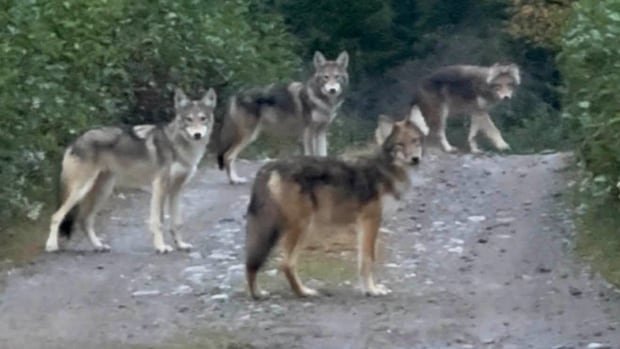
Recently, attention was drawn to the possibility of wolves on the island when Nikita Compton shared online images of a small group of animals near Goose Arm, sparking curiosity. Speculation arose about whether they were a hybrid of coyotes and dogs or possibly coyotes and wolves.
While identifying these animals without testing is challenging, wildlife officials aim to enhance their knowledge of the overall canid population. The Department of Forestry, Agriculture and Lands of the Government of Newfoundland and Labrador, which oversees the Wildlife Division, mentioned that a Newfoundland wolf subspecies, believed to be distinct from Labrador wolves, became extinct in the 1930s. However, Labrador gray wolves have been more recently observed on the island, with documented cases in 2008 and 2012.
Since 2013, the Wildlife Division has been investigating the movement of these animals. Genetic analysis of approximately 500 canid carcasses collected in the province revealed that while five animals had ancestry featuring a mix of coyote and domestic dog, four animals from the island were confirmed as Labrador wolves. Additionally, 28 samples showed evidence of some wolf DNA.
The province notes that the wolf population on the island remains low, with genetic evidence indicating interbreeding between wolves and coyotes. Despite the potential for coyotes to exhibit diverse characteristics, it is not necessarily indicative of recent wolf or dog hybrids.
The public’s interest in the canid mystery is encouraged, as it can contribute to ongoing research on animal life in the region. Hunters and trappers are incentivized to submit coyote and wolf carcasses for further examination, providing valuable insights into the effects of coyotes’ presence on the island and the potential migration of wolves from Labrador.
Furthermore, efforts are being made to increase the number of canid samples from Labrador to enhance the detection of animals with wolf genetic ancestry. The Wildlife Division urges hunters and trappers in Labrador to report any canid carcasses they come across.
Regarding encounters with coyotes or wolves, provincial wildlife authorities emphasize that these animals are rarely aggressive towards humans. In such situations, individuals are advised to remain calm, avoid running, and make noise if approached by the animal, such as yelling or clapping. It is recommended to appear larger by waving arms and slowly backing away if the animal persists.
Overall, public safety measures and cooperation with wildlife officials are crucial in understanding and managing the diverse canid population in Newfoundland and Labrador.