

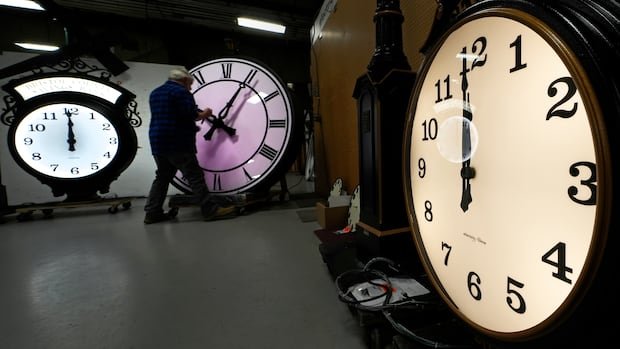

In a move that could have implications for timekeeping, an international timekeeping body in France has decided to eliminate “leap seconds,” allowing clocks to gradually fall out of sync with the Earth’s rotation over potentially centuries or even millennia. The concept of leap seconds was introduced more than 50 years ago to reconcile the discrepancy between precise atomic time, derived from atomic vibrations, and solar time based on the sun’s position relative to Earth. Initially, ten seconds were added in 1972 to align these two time systems.
Since then, the International Earth Rotation and Reference Systems Service has been monitoring the difference between atomic time and solar time to determine when to insert an extra second. Leap seconds have been introduced 27 times, with the most recent one occurring in 2016. The decision to abandon leap seconds comes as managing these adjustments becomes increasingly challenging with the growing dependence on accurate timekeeping systems.
If leap seconds were not applied, the impact would not be noticeable in our lifetimes. However, over time, the discrepancy could lead to unusual scenarios like daylight coinciding with midnight and darkness with noon. The rationale behind leap seconds is similar to leap years, where an additional day is added every four years to keep the Gregorian calendar in sync with the seasons.
However, leap seconds have posed challenges for various industries reliant on precise timekeeping, prompting discussions to phase out these adjustments. The potential risks associated with leap seconds include system failures and disruptions, as seen in incidents involving Reddit, LinkedIn, and Cloudflare in past years.
Moreover, recent observations suggest that the Earth’s rotation has accelerated, raising the prospect of a need for a “negative leap second” in the future, which could have significant implications for software systems. The decision to accumulate extra seconds and adjust clocks by a full hour after reaching a total of 3,600 seconds is seen as a long-term solution to mitigate potential disruptions caused by leap seconds. This change is scheduled to take effect in May 2027.
While some experts support the move to eliminate leap seconds, others express concerns about the impact on technology-driven economies. The complexities surrounding Earth’s rotation variations and the challenges of maintaining accurate timekeeping systems point to the inherent difficulties in achieving perfect synchronization. Ultimately, the ongoing debate underscores the enduring challenge of harmonizing human-made time systems with the natural rhythms of the universe.