

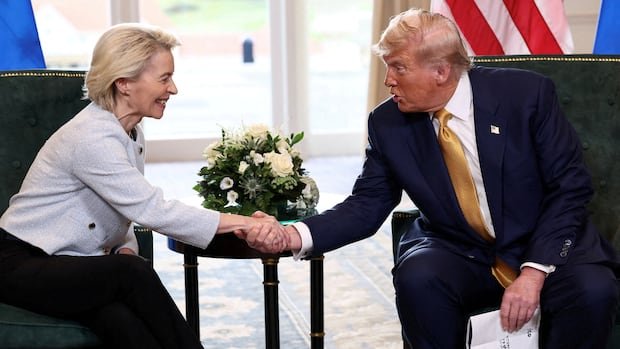

European Union chief Ursula von der Leyen made assurances to Europeans last year while at Donald Trump’s Turnberry golf resort in Scotland that agreeing to a blanket 15% U.S. tariff on EU exports would bring “predictability and stability.” However, some critics now view the trade deal as a one-sided surrender that paved the way for continuous American economic pressure.
The initial move by the U.S. to reclassify certain European industrial goods for higher tariffs was followed by a dispute over European plans to impose a digital services tax on U.S. tech giants. This conflict mirrors Washington’s recent efforts to dictate tax terms to Ottawa.
Shortly after the European Parliament ratified the Turnberry deal, Trump threatened on Truth Social to impose 100% tariffs on any European nation that implements or expands tech taxes. In response to Trump’s demands, European lawmakers are considering Mark Carney’s departure from the U.S. trade talks as a model for standing up to coercion.
Former French ambassador Gerard Araud suggested that Canada should lead by example in dealing firmly with Trump, emphasizing the importance of unity among democratic nations.
European leaders have not publicly defended Carney in the trade dispute, but they privately admire Canada’s strategy of walking away from negotiations with Trump. This approach is seen as a way to increase pressure on Washington for better trade terms.
While Europe has been reluctant to confront Trump on trade issues, the situation changed when the U.S. president attempted to coerce Denmark into ceding Greenland. This move sparked condemnation across the EU and led to a Danish and European military response.
Britain’s pursuit of trade stability with Trump has fallen short of expectations. The UK’s trade deal with the U.S. resulted in tariffs on exports, diminishing its competitive advantage. Facing threats of 100% tariffs over a digital services tax, British officials signaled a willingness to reconsider the tax.
Trade experts caution that replicating Canada’s approach may be challenging for Europe or the UK due to differences in public support and economic endurance. The erosion of political will in negotiating with the Trump administration affects not only Canada but also European allies.
A decline in confidence in Trump’s leadership is evident globally, with traditional allies like Germany and Canada expressing lower reliability ratings. Despite setbacks, final trade deals are never truly final, and failed negotiations can be revived to achieve a better outcome.