

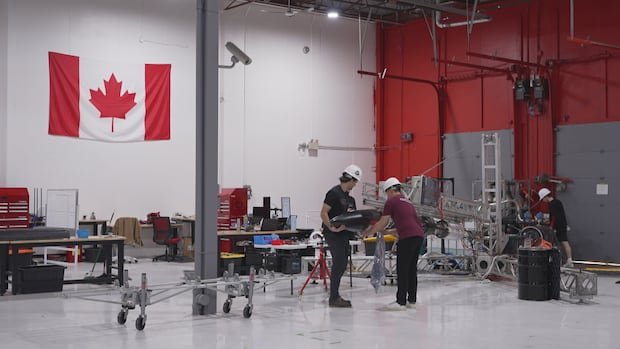

Canada, the only G7 nation lacking its own rocket launch capabilities, is striving to develop a Canadian-made rocket. Various Canadian companies are in a race to provide the country with a means to access space independently. This effort is intensified as concerns arise among some SpaceX customers about potential reduced access to orbit rides.
The challenge for rocket companies lies in completing a costly task within strict timelines and amidst evolving government priorities. With Canada’s current inability to launch rockets domestically, customers, including private enterprises and government entities, rely on external providers to deploy their satellites into orbit. Notably, SpaceX launched all 12 Canadian satellites in 2025, highlighting the nation’s dependency on foreign launch services.
The critical role of technology in telecommunications, military applications like threat detection, and earth observation, such as wildfire monitoring, underscores the significance of controlling launch capabilities. Marc Boucher, founder of SpaceQ, emphasizes the importance of securing Canada’s own launch capabilities to safeguard against potential refusals from foreign entities to launch Canadian technology.
The Canadian government has acknowledged space as a key sovereign capability and introduced legislation to authorize launches from Canadian soil. Recent funding initiatives, including $8.3 million allocated to three Canadian companies, aim to support the development of light-lift rocket capabilities by 2028. NordSpace, one of the recipients, faced an initial unsuccessful suborbital rocket test in 2025 but plans to reattempt soon. Reaction Dynamics, another participant, is focused on a unique engine design with the aim of achieving orbit readiness by 2028, aligning with government targets.
The emergence of Canada Rocket Company adds to the dynamic, with plans to build a medium-lift rocket capable of deploying numerous satellites into low Earth orbit simultaneously. The company’s ambitious goals include constructing a $30-million test facility in London, Ontario, to facilitate progress towards its 2032 launch target. Private investments, along with government funding, are crucial in overcoming historical funding challenges that have hindered rocket development in Canada.
The impending transition of SpaceX’s Falcon 9 rocket to the larger Starship vessel poses concerns for satellite customers reliant on Falcon 9 launches. The potential shift has spurred emerging rocket makers, like Canada Rocket Company, to position themselves to capture market share left by SpaceX’s transition. However, the industry faces challenges, including reduced access to rideshare programs, potentially affecting smaller players seeking experimental satellite launches.
As efforts to establish Canadian rocket launch capabilities progress, industry leaders emphasize the necessity of sustained funding and long-term commitment. The journey towards regular space launches from Canada is envisioned as a gradual process, requiring substantial financial support and collaboration between public and private sectors to achieve successful orbit deployments.