

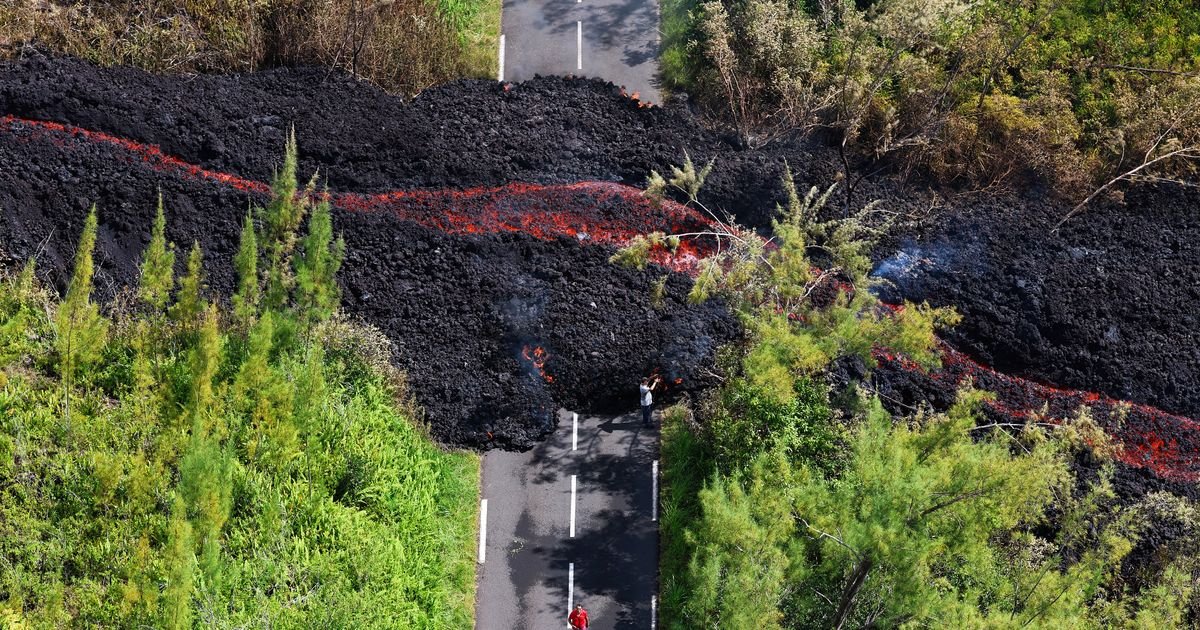

Two streams of molten lava have flowed from a volcano, dividing a national road on an island. Stunning images depict the lava coursing through a forest and over the RN2 road close to Sainte-Rose on Réunion, a French overseas territory in the Indian Ocean. The lava emanated from the Piton de la Fournaise volcano situated on the eastern side of the island, renowned as one of the most active volcanoes globally.
Piton de la Fournaise, translating to ‘Peak of the Furnace,’ is a shield volcano characterized by broad, gentle slopes shaped by frequent, fluid basaltic lava flows, similar to the volcanic activity observed in Hawaii. Standing at 8,635 feet above sea level, the volcano covers almost a third of the island’s area. This 500,000-year-old volcano, designated as a UNESCO World Heritage site in 2010, typically erupts about once a year, resulting in lava flows descending the caldera’s slopes.
The volcano erupts approximately every nine months, without posing a threat to the densely populated island of 860,000 inhabitants. In 2017 alone, it erupted three times, as reported by France’s official tourism website. While eruptions usually remain within the caldera, occasionally, lava flows breach the RN2 road, as witnessed recently— an event not seen in almost two decades, according to Réunion’s prefecture speaking to AFP on Friday. The highway had encountered destruction several times in the early 2000s, necessitating significant engineering efforts for restoration post the lava cooling down.
Occurrences of eruptions outside the caldera are exceedingly rare, with only six documented instances, the most recent recorded in 1986. In 1977, the village of Piton-Sainte-Rose was evacuated before a lava flow crossed the highway, resulting in the destruction of several structures. The lava flow encircled the local church, entered through its entrance, and remarkably halted, saving the building from destruction. The church was later reinstated for use and renamed Notre-Dame des Laves (‘Our Lady of the Lavas’). It is noted that around 400,000 individuals visit the volcano annually, as per information from France’s tourism website.
The island’s other volcano, Piton des Neiges (‘Snow Peak’), also a World Heritage site, stands as the island’s highest point at over 10,000 feet. This volcano, which commenced forming over 2.4 million years ago, has remained inactive for the past 22,000 years, as indicated in a 2012 study published in the Geomorphology journal. Both volcanoes are encompassed within Réunion National Park, recognized for its diverse range of wildlife and plant species.