

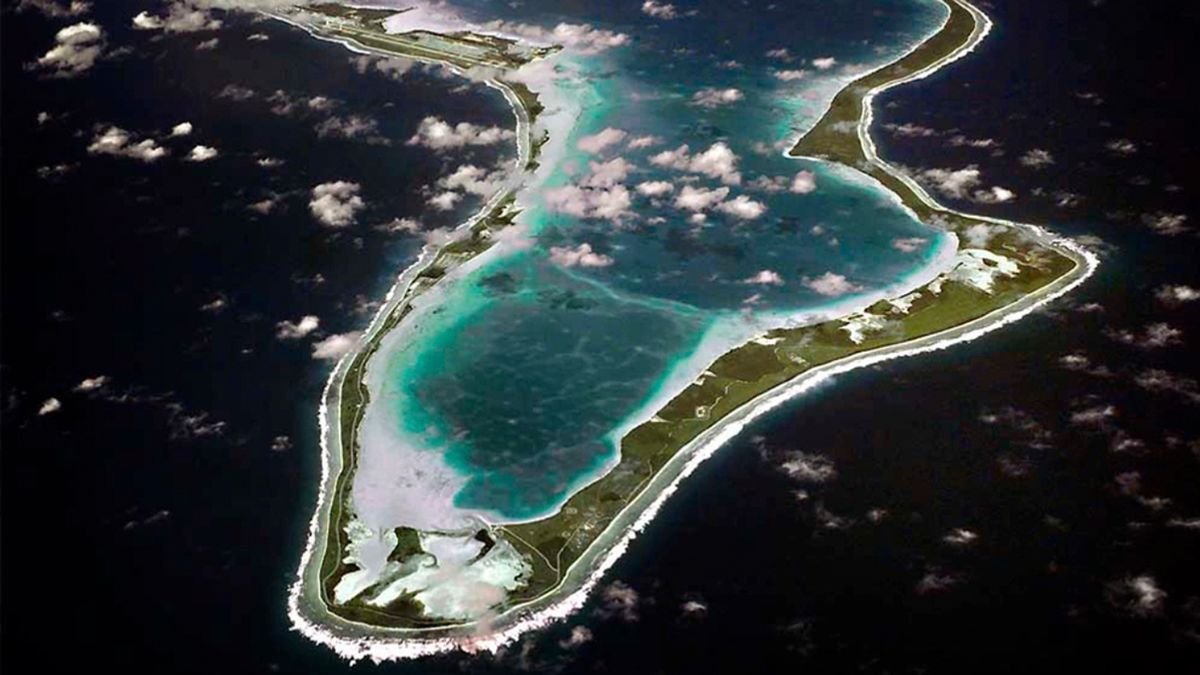

Iran launched missiles towards Diego Garcia, a disputed UK-US military base, in an overnight attack spanning 2,000 miles, as confirmed by officials. The Middle Eastern country fired two intermediate-range ballistic missiles towards the Indian Ocean base, located 2,500 miles away, on Friday night. One missile malfunctioned mid-flight, while the other was intercepted by a US warship using an SM-3 Interceptor.
This incident has once again drawn attention to the controversial military base, which has been a focal point in UK-US relations, especially since Donald Trump’s return to the White House. Diego Garcia, a secluded British Overseas Territory established in 1960, remains shrouded in secrecy and is primarily operated by US authorities, despite being administered from London.
Although the base houses only a few hundred military personnel from the US Air Force, US Navy, and British forces, its total personnel count stands at 360. The majority of personnel are from the USN and USAF, with a smaller contingent of “Brit Forces” personnel. Additionally, the base hosts a significant civilian population, including around 1,800 US operational personnel, 80 overseas government employees, and approximately 300 mariners.
Despite its relatively small personnel count, Diego Garcia boasts robust military capabilities, predominantly serving the US military. The base features extensive runways supporting various aircraft, radar installations, control towers, and a deep water port capable of accommodating and servicing naval vessels passing through the region.
Primarily utilized as a launchpad, Diego Garcia has played vital roles in past military operations like the 1991 Gulf War and the 2003 Iraq War. More recently, the US has used the base for operations against the Houthis in Yemen. With a strong US presence, the island’s strategic significance is anticipated to persist as the UK pursues a lease agreement.
Following negotiations, the UK government agreed to a £3.4 billion deal with the US, allowing Mauritius to lease the base for 99 years at a cost of approximately £101 million annually. While US officials support the agreement for ensuring long-term security, there have been conflicting views, notably from Donald Trump, who has alternated between criticizing and praising the deal.
Trump’s wavering stance has left the agreement in uncertainty, prompting Mauritius to explore legal avenues to push for its approval. Prime Minister Navin Ramgoolam expressed concerns over a budget deficit due to the unresolved situation, indicating the nation’s determination to pursue legal actions to address the issue.