

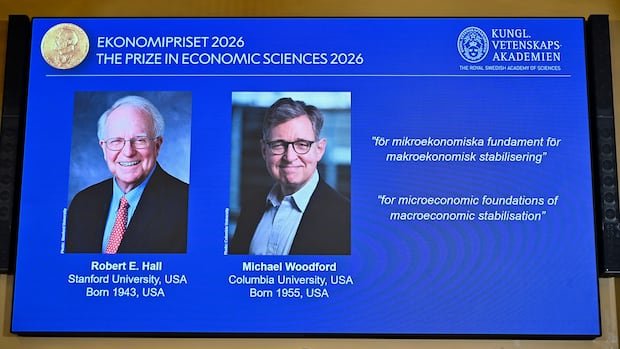

American economists Robert E. Hall and Michael Woodford, both born in the U.S., were awarded the Nobel Memorial Prize in Economics for their groundbreaking research in developing models that aid governments and central banks in navigating economic shocks. The Royal Swedish Academy of Sciences made the announcement in Stockholm, highlighting the laureates’ contributions in assisting policymakers in managing economic fluctuations.
Robert E. Hall is associated with Stanford University in California, while Michael Woodford is affiliated with Columbia University in New York. Woodford expressed his surprise and gratitude for the prestigious honor during a phone call with the committee from New York.
Their work has provided a robust theoretical basis for the models currently utilized by central banks and governments globally, according to John Hassler, the chair of the Committee for the Prize in Economic Sciences. This foundation has enhanced the ability to address economic disturbances such as energy crises and sudden shifts in consumer spending patterns.
In the past, governments followed the Keynesian approach of stimulating the economy by cutting taxes and increasing government expenditures to spur consumer and business activity. However, this approach faced challenges during the 1970s stagflation period, exposing its limitations. Hall and Woodford pioneered a more refined model that considers the decision-making processes of consumers and businesses regarding investments and expenditures.
Their innovative contributions have laid the groundwork for a new era in stabilization policy, as acknowledged by Hassler. The Nobel Prize in Economics, formally known as the Bank of Sweden Prize in Economic Sciences in Memory of Alfred Nobel, was established in 1968 to commemorate Alfred Nobel’s legacy. While technically not a Nobel Prize, it is traditionally presented alongside the other Nobel Prizes on December 10, the anniversary of Nobel’s death in 1896.
Recent Nobel laureates were also recognized in the fields of medicine, physics, chemistry, literature, and peace. The prize money for this year amounts to 12 million Swedish kronor, approximately $1.7 million Canadian dollars, awarded to individuals, small groups, or organizations.