

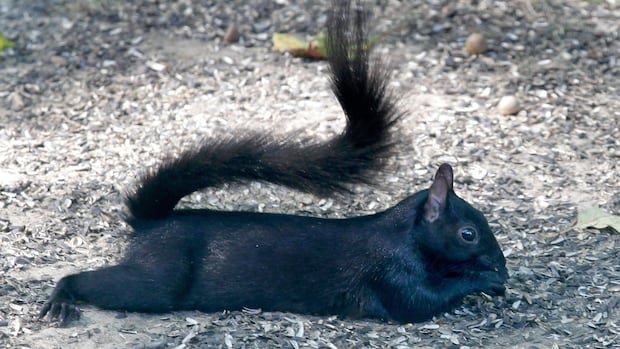

Francis Quang-Hai Dinh spent his first summer at McGill University exploring Montreal’s parks on his bicycle, studying squirrels. He visited nearly 200 green spaces, from Mirabel to Saint-Bruno, documenting over 800 grey and black squirrels. What began as an undergraduate project evolved into a personal mission to understand how the city’s geography and water systems influence evolution subtly.
Dinh, who is currently pursuing integrative biology at the University of Illinois Urbana-Champaign, became enamored with squirrels, considering them more than mere pests. Due to limited transportation options in suburban areas, he relied on his bike to conduct the unique manual survey of squirrels in each park, a method not previously undertaken by any other researcher.
His research revealed that approximately 12% of Montreal’s squirrels are black, with a higher concentration of black squirrels found further north. In regions just north of Laval, up to 40% of squirrels were black, while on the island of Laval, the figure was about 20%. On the island of Montreal, it was around 15%, and on the south shore, it dropped to only two or three percent. The study attributed this distribution to temperature variations, as black squirrels can better absorb heat due to their darker coloration.
The study’s lead author, Allison Roth, an assistant professor at the University of Missouri and former McGill postdoctoral fellow, emphasized that the research focuses on using squirrels as a model to explore how urban environments prompt evolutionary changes. Roth highlighted Montreal’s unique environmental diversity, shaped by the St. Lawrence River and its tributaries, fostering distinct genetic and physical adaptations within the local squirrel population.
The study, titled “Fine-scale spatial variation in eastern grey squirrel melanism across a complex urban landscape,” presents a detailed analysis of squirrel coloration patterns in Montreal’s neighborhoods. Contrary to previous beliefs that urban development solely drives wildlife changes, the study underscores that urbanization’s impact on local temperature, vegetation structure, and natural barriers like rivers plays a significant role in evolutionary patterns.
Dinh concluded that the experience has transformed his perspective on wildlife coexisting with urban landscapes. He emphasized that despite human modifications, wildlife will persist and adapt, challenging the notion of a strict divide between city life and nature.